 Eyeglasses by Kazuo Kawasaki

The highly respected former chairman of the Federal Reserve, Alan Greenspan, launches a harshly critical attack on President George W. Bush’s economic competence in his memoir published tomorrow.
While his declaration that America’s prime motive for the Iraq war was oil will set off one political storm, his onslaught against Republican fiscal mismanagement will cause another, just as the economy becomes a big issue in the primary election campaign.
Greenspan’s 531-page book will do little to restore faith in the Bush administration’s claims of economic proficiency at a time when the markets are deeply unsettled. He has harsh words for Bush, the vice-president, Dick Cheney, and the Republicans over their big spending and lack of financial discipline. They are contrasted with former president Bill Clinton, whom Greenspan clearly admires.
 LAKELAND -- Online job hunters have their Monster, and Polk County students in need of volunteer work now have a Sweat Monkey. SweatMonkey.com, the internet creation of a 16-year-old Lakeland resident, will be introduced Thursday during an information session at Florida Southern College.
The web site aims to eliminate one frequent headache in the lives of high school students: finding volunteer opportunities to satisfy graduation requirements.
Founder Callahan Fore wants to make the process easier by having local non-profit groups post their volunteer jobs to the free site, which also will track and verify the number of hours served by individual members.
Fore also hopes that private businesses will use the site to attract teenage candidates for paying jobs. [....]
Sweat Monkey, whose slogan is "Off the Couch and On the Job," includes a board of directors comprised of Polk high school students and has already seen interest from entities like United Way, Big Brothers Big Sisters and Volunteers in Service to the Elderly.
"Anything that makes it simpler to connect a person with a volunteer opportunity is good for the community," said Terry Worthington, president of the United Way of Central Florida. [....]
Use of Sweat Monkey is free to students, organizations and employers, and the site has applied for non-profit status.
Washington has cleared the way for Russia to join the World Trade Organisation, ending years of bitter wrangling between the two ex-rivals. Presidents George W Bush and Vladimir Putin are to toast the accord in Moscow next week, marking Russia's arrival as a full member of the global system nearly two decades after the fall of Communism.
Telegraph report. . . here.
This appears to be a positive development for Russia, the US and the world.
The bilateral agreement does not make Russia's membership in the WTO a done deal, but perhaps it will provide an impetus for Russia to resolve lingering differences with neighbors Georgia and Moldova.
Update, Nov. 19: Russia signs key trade deal with U.S.
According to CNN Money, "the real estate slump could get worse before it gets better. But these 10 markets offer great opportunities for those who have the patience to buy and hold."
WASHINGTON, Oct 26 (Reuters) - Former Federal Reserve Chairman Alan Greenspan said on Thursday the U.S. economy was pulling past a sharp housing-sector downturn....
"There are early signs of stabilization," Greenspan said of the U.S. housing market, although he added: "It's not over."
"Most of the negatives in housing are probably behind us," Greenspan said. "The fourth quarter should be reasonably good, certainly better than the third quarter."
Our institutions have all moved from their idealism, through pragmatism to dogmatism. Referencing contemporary historian Thomas Cahill and Canadian economist Jane Jacobs, Lakeland Ledger guest columnist Dale Braiman contends that the dark age has already descended.
Look around you. Gated communities keep out the riffraff, just as they did in the Dark Ages. They did not have SUVs then, but these tanks are dark-age as well. The church not only plays an increasingly powerful role in politics and policy, but the Bush administration is silencing scientists who dare speak up. Church over science is dark-age. There is a snowballing of the separation between rich and poor exacerbated by Bush tax cuts. Dark age.Continue article . . . Look for nation's reflection in history
Heaven help us, but our government has not only begun to torture people but has recently advanced the argument that it is OK to do so for national security. Dark age. The relationship between Christians and Muslims is almost too obvious to mention. Dark age.
The most striking feature is the forgetting of culture. Wrapped in a religious zeal, the affinity for the free market has turned our universities into vocational schools for corporations. Even the best and brightest among us are now prepared to make the big bucks with only minimal preparation to be citizens of a democracy. When was the last time Americans took the same pride in voting as did the Iraqis? Dark age.
What are we non-billionaires to do?
This article was published 13 Dec 2005 by Fortune: Richard Rainwater doesn't want to sound like a kook. But he's about as worried as a happily married guy with more than $2 billion and a home in Pebble Beach can get. Americans are "in the kind of trouble people shouldn't find themselves in," he says. He's just wary about being the one to sound the alarm.
[....]
Rainwater is no crackpot. But you don't get to be a multibillionaire investor—one who's more than doubled his net worth in a decade—through incremental gains on little stock trades. You have to push way past conventional thinking, test the boundaries of chaos, see events in a bigger context. You have to look at all the scenarios, from "A to friggin' Z," as he says, and not be afraid to focus on Z. Only when you've vacuumed up as much information as possible and you know the world is at a major inflection point do you put a hell of a lot of money behind your conviction.
[....]
Such insights have allowed Rainwater to turn moments of cataclysm into gigantic paydays before.
[....]
The next blowup, however, looms so large that it scares and confuses him. For the past few months he's been holed up in hard-core research mode—reading books, academic studies, and, yes, blogs. Every morning he rises before dawn at one of his houses in Texas or South Carolina or California (he actually owns a piece of Pebble Beach Resorts) and spends four or five hours reading sites like LifeAftertheOilCrash.net or DieOff.org, obsessively following links and sifting through data. How worried is he? He has some $500 million of his $2.5 billion fortune in cash, more than ever before. "I'm long oil and I'm liquid," he says. "I've put myself in a position that if the end of the world came tomorrow I'd kind of be prepared." ....
Fortune article...

The United States is now facing a predicament similar to the one the Soviet Union confronted some two decades ago. There is a great deal of discussion, among those few who try to think for themselves, about the right way to respond to the permanent energy crisis that has already started to grip the country. The entire American way of life is an artificial life support system that runs on fossil fuels, and it is going to get knocked out as these fuels run low. Of the few people who have any notion that this is happening, even fewer can imagine what might come next, beyond the gut feeling that it will be unpleasant. - Dmitry Orlov, Our VillageDmitry Orlov is the general director of the Agency of Political and Economic Communications, a Moscow based think-tank. Earlier this year, From the Wilderness published his essay, "Post-Soviet Lessons for a Post-American Century":
Through his comparison and contrast of the Former Soviet Union to the U.S., Dmitry provides us with one of the most penetrating analyses of post-peak that I have read. This article is packed with original insights derived from personal experience. The picture which Dmitry paints is unsettling, but it is far better than jumping feet first into darkness. The impending breakdown of the US and world economies is here clarified to the point that you can begin to prepare for this eventuality. And this article gives some of the most practical suggestions on how to prepare.Orlov's essay is in three parts and takes a while to read, but it is time well spent. I don't necessarily agree with all his points, but he gives us much to ponder. I've been thinking for some time -- especially in the past five years -- that preparing for a self-sustaining livelihood may not be such a bad idea.
Before presenting the article, perhaps we should emphasize one major difference between the collapse of the Soviet Union and the dissolution which now confronts us. Russia was able to survive the collapse and stage a comeback because it was largely a political and economic collapse. Russia still had a rich resource base, and most importantly vast energy reserves. Moreover, it was a regional collapse; there was a healthy world outside of Russia to which it could turn for aid, albeit at an exploitive price. Following the global peak of oil and the worldwide, irreversible decline in energy production, there will be little left on which to stage a comeback. Any economy which is dependent on hydrocarbon energy will be slowly constricted. Dmitry mentions this in his article, but it bears repeating. In this sense, the collapse of the Soviet Union could be viewed as a dress rehearsal for what is to come. - Dale Allen Pfeiffer, FTW Science Editor
NEW ORWELLIAN TIMES: The financial experts at Fox News make the job of reporting for the New Orwellian Times almost as easy as flicking the television remote.
On today's Cavuto on Business, for example, Ben Stein, author of "Yes You Can Still Retire Comfortably," offered sage advice to people nearing retirement but concerned by the possibility of an inconvenient disaster:
The NO Times, taking cues from Stein and the "Cost of Freedom" experts, suggests these additional precautions:
- own a second home in a different geographical location;
- keep large quantities of cash in the house because automatic teller machines will be inoperative after a disaster.
Now, before facing the next time of crisis, please print these suggestions and, after consulting your certified financial planner and your estate attorney, incorporate the pointers into your own personalized contingency plans.
- expect the unexpected;
- keep family jewels, stock certificates, wills and insurance documents in a safety vault;
- keep the Hummer and Cruisemaster tanks topped off for a quick getaway;
- write a check for a substantial sum to your favorite political party (you know the one);
- for god's sake, don't take unnecessary personal risks until the "death tax" is repealed.
Earlier this week I mentioned Jack Welch's interview on CNBC's Squawk Box. I'm still waiting to hear that he's been named the gulf coast czar. Stay tuned....
Welch was mentioned again today in an interesting article by Nikki Finke in LA Weekly:
If big media look like they're propping up W's presidency, they are.Read the entire column: Media moguls, not looters, killed Katrina's truth tellers
Once upon a time, large corporations and their executives typically avoided any public discussion of their politics because partisan positions alienated customers and employees. But all of that changed after GE bought NBC in 1986. For seemingly eons, Immelt's predecessor, the legendary Jack Welch, was a rabid right-winger who boasted openly about helping turn former liberals Chris Matthews and Tim Russert into neocons. (And Los Angeles Representative Henry Waxman is still waiting for GE to turn over those in-house tapes that would prove once and for all whether Welch, in 2000, ordered his network and cable stations to reverse course and call the election for Bush instead of Gore.)
.... But the real test of pathos vs. profit is still before us: whether the TV newscasters will spend the fresh reservoir of trust earned with the public to not only rattle Bush's cage but also battle their own bosses. If not, it won't be long before TV truth telling will be muzzled permanently.
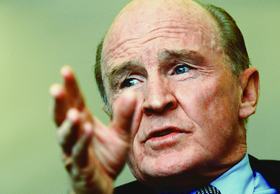
Jack Welch, GE's retired CEO who was known as "the king of shareholder value," was a guest of CNBC's "Squawk Box" this morning.
When asked about the damage the high cost of Katrina could do to the federal budget, Welch sanguinely predicted that the $200 billion, going into rebuilding projects and jobs, will flow through the economy, providing a stimulative effect, "just as the tax breaks did."
Wow. The heads of the military-industrial complex and their Republican subsidiary get it: federal spending. And it ain't such a bad thing -- not when it's flooded through the proper channels.
These are the "investor class" folks who mailed $300 checks with one hand while pouring unconscionable tax breaks on the filthy rich with the other. Middle class workers are now picking up the tab: over $1700 in additional state and local taxes and fees each year and a federal deficit spinning from a tropical depression into a full-flown hurricane.
Only ideology and blind greed (excuse the redundancy) keep those in the cradle of power from seeing that $200 billion spent on the country's infrastructure before a catastrophe like Katrina would have provided as much economic stimulation as it will after it's too late to help those who died and suffered because of government inaction, incompetence and willful ignorance.
"Chris Cox is the right man to carry on this important work."
- George Bush (upon naming Rep. Cox to head the Securities and Exchange Commission)
"There is a reason that fiscal restraint is a traditionally conservative value. Big government requires big spending and, therefore, a comfort level in taking and using the fruits of other people's labor. It is a comfort level found in socialism, not conservatism."
- Christopher Cox
"The people at the top of America's money pyramid have so prospered in recent years that they have pulled far ahead of the rest of the population."
- New York Times, Richest Are Leaving Even the Rich Far Behind
Changes To Federal Formula Causing Financial-aid Crunch For Families Paying College Bills
"The Times found that families with the same earnings and assets as they had in 2000 would typically have to pay an extra $1,749 before clearing the eligibility bar for financial aid in 2005, after adjusting for inflation.
"'For some of those students, it's the difference between enrolling and not enrolling.'" Seamus Harreys, dean of student financial services at Northeastern.
"The department's estimates for inflation were, in fact, far enough off that it has now revised the formula it will use for the 2006-2007 school year, much to the benefit of families with assets."
-New York Times, Financial Aid Crunch


 Posts
All Comments
Posts
All Comments


